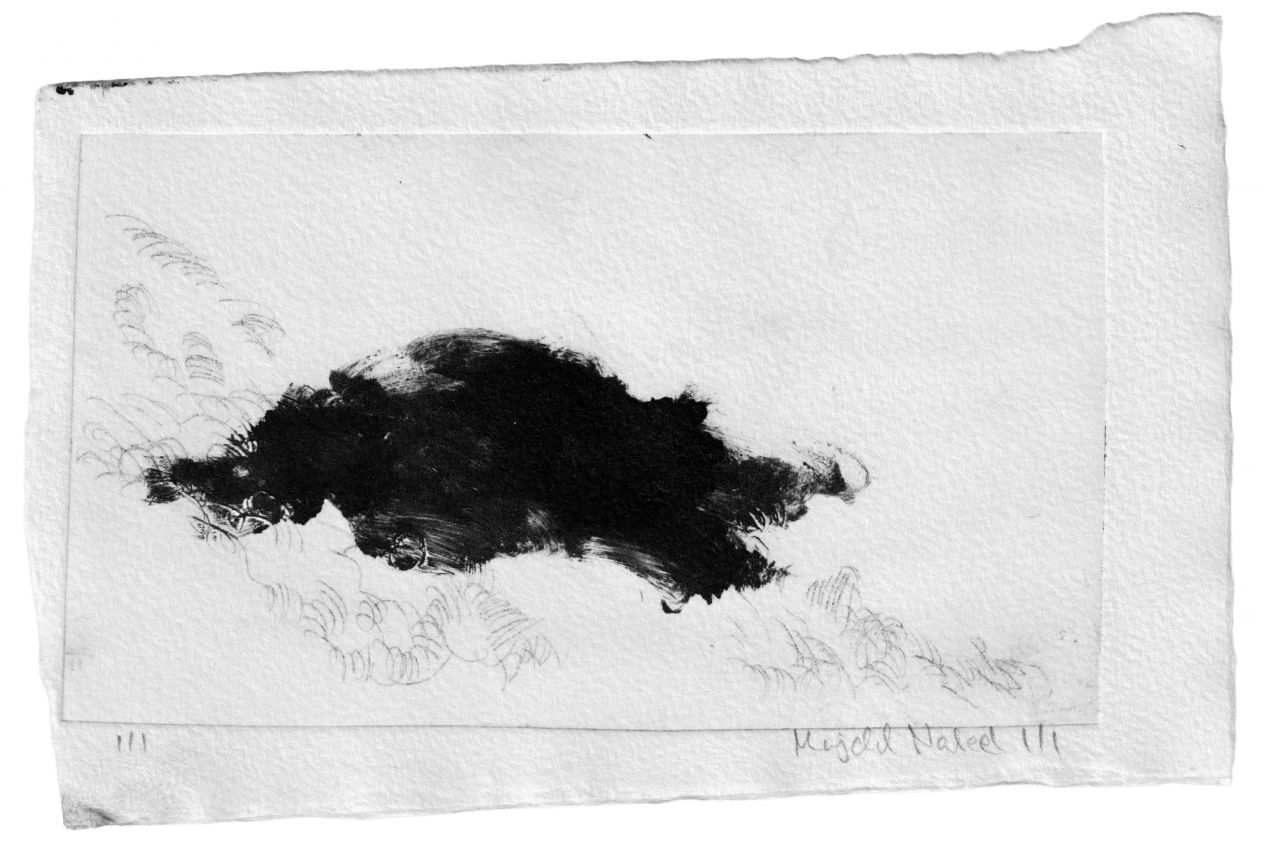
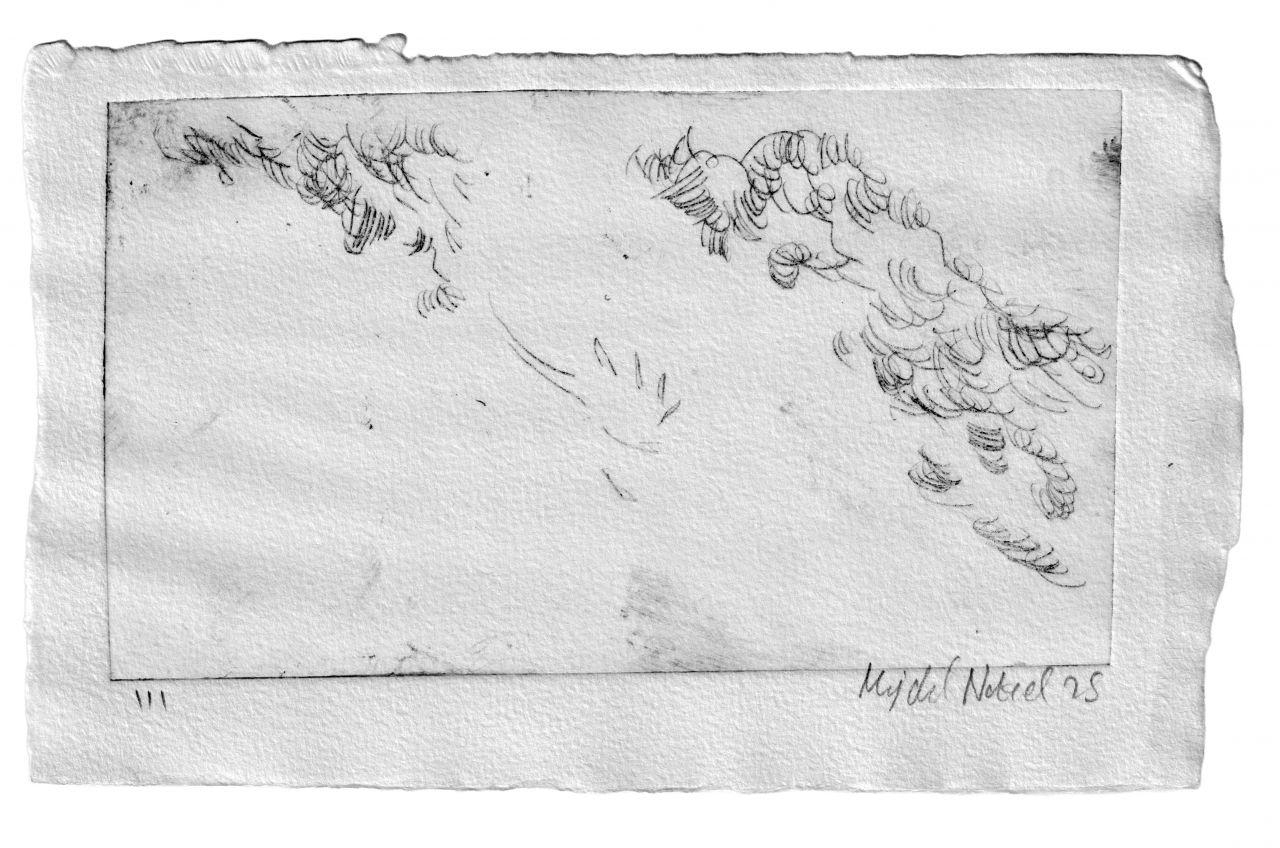
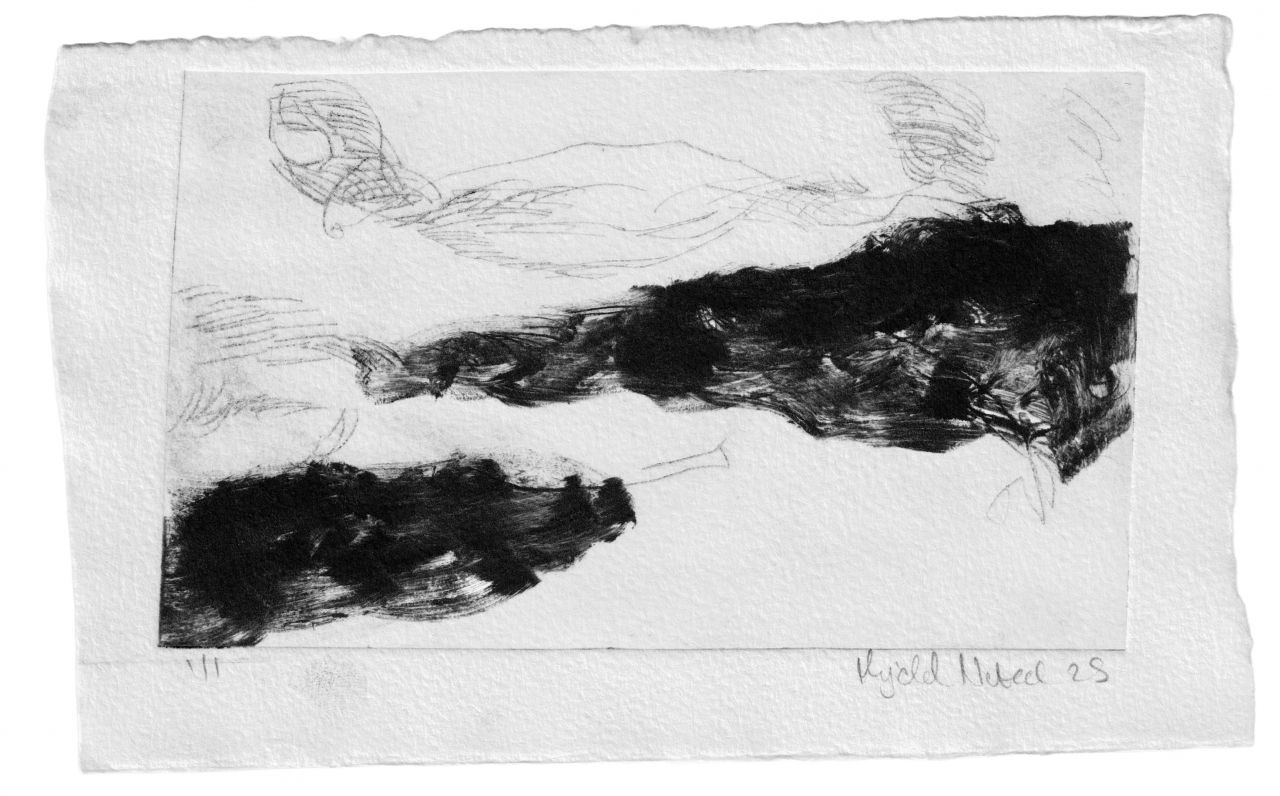
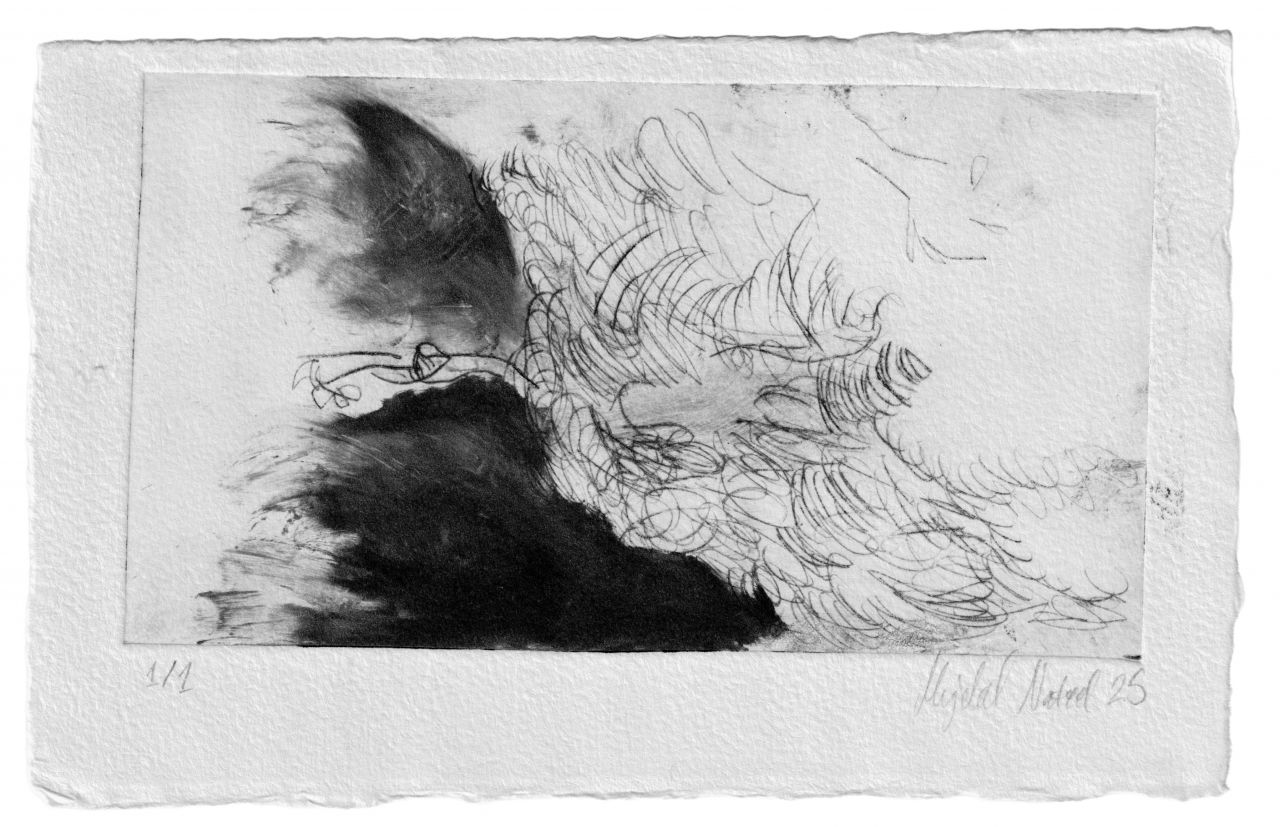
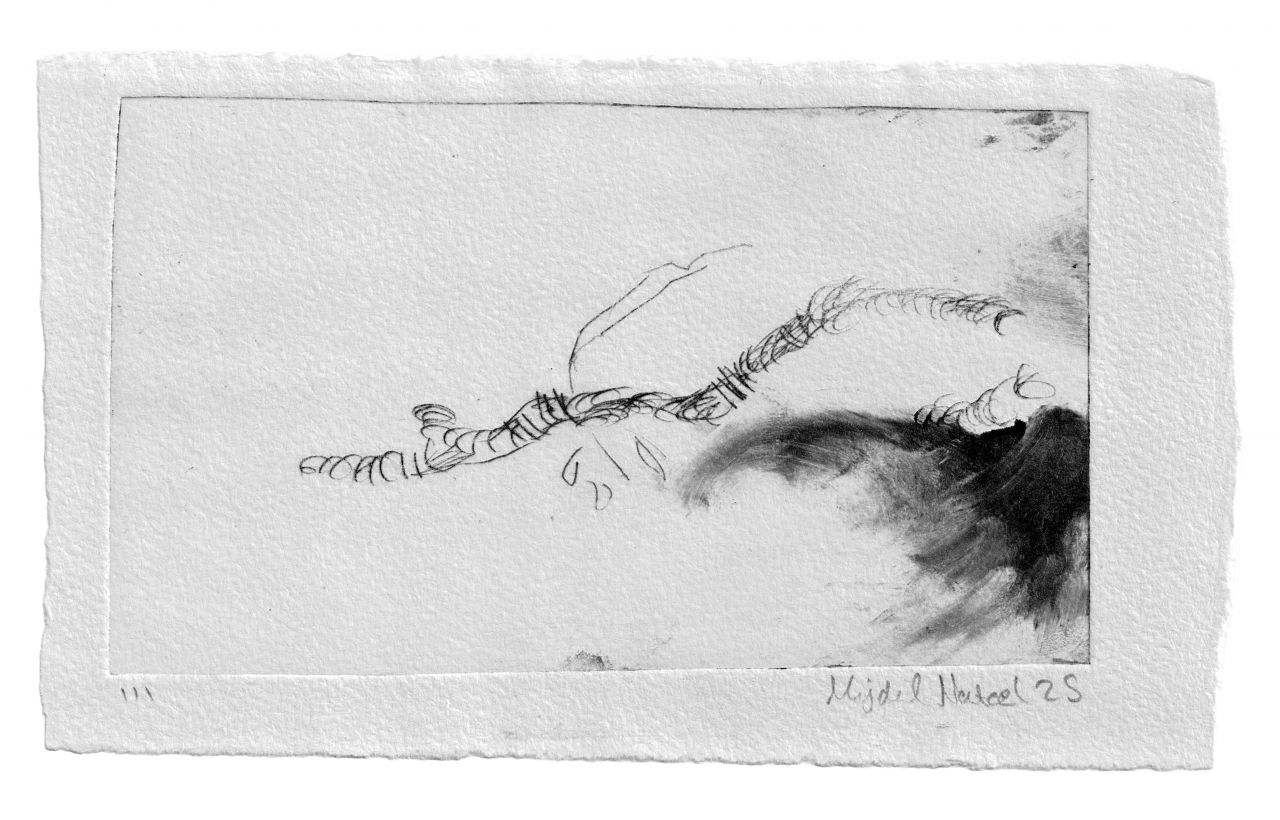
The concept of amputation, which the artist has been developing in her practice since 2020, takes on new meaning in this cycle. Beyond its physical and spatial dimensions of loss, it also encompasses the rupture of personal, familial, and cultural continuities. The destruction of her own home during the war in Gaza also meant the loss of her entire body of previous artistic work, making the question of memory, personal archive, and the continuity of artistic practice one of the central starting points of this cycle.
The exhibition brings together prints made in drypoint, while a video projection links the individual sheets into a single whole. Drawing on photographs sent to her by her family during their forced displacement in Gaza, the artist does not relay them in a documentary way, but translates them into a graphic language of traces, fragments, and voids. The process of carving the matrix plate thereby becomes more than a technical procedure — the etched trace and the print become elements through which the artist explores what remains after loss, while the printmaking process allows experience to be translated into material trace. Fragmentary scenes, stark black-and-white contrasts, and a rhythm of repetition do not reconstruct events, but create a space in which the consequences of war manifest themselves in ruptures, voids, and absence.
Majdal Nateel (b. 1987) is a Palestinian visual artist and researcher who grew up in Gaza and now lives and works in Sweden. She graduated from Al-Aqsa University in Gaza and is a co-founder of the artist collective Dahaleez. Her artistic practice explores the relationships between body, space, and collective memory in the context of war and forced migration. She has exhibited in Palestine, the United Kingdom, Canada, the United States, Italy, and Switzerland, and has taken part in numerous international residencies and exhibitions.
Curator: Kristina Bonjeković Stojković
The exhibition has been realized within the Museum of Solidarity framework, part of the international Museum of the Commons project by the L'internationale network which offers support to Palestinian artists whose work and livelyhood has been effected by war and displacement.
_______________________
Majdal Nateel
Studying the Void of Amputation 2025
This work originates from my personal experience between October 2023 and 2025. Although Studying the Void of Amputation was the title under which I had previously produced my work in Gaza — following the Great Return Marches through 2021 — in order to draw parallels between the physical and geographical dimensions of amputation wrought by the military apparatus, I seek here to examine further dimensions of amputation operating on emotional and moral planes.
After 2023, amputation assumed another form. As I followed my family's forced displacement in Gaza and endured the successive loss of our home and family members killed by the Israeli military, my first collection, Studying the Void of Amputation, was simultaneously lost beneath the rubble of our house. This loss constituted a new dimension of amputation, shifting the project's inquiry from investigating the void within the amputated body and amputated geography, to investigating what had also been severed: a personal artistic archive and memory.
This work is a personal document produced through drypoint. I found in the act of incising varied surfaces an embodiment of the ongoing scenes of existential erasure; and the investigation of the incised trace through printmaking techniques constitutes, in turn, a material tracking of the trace of the amputated — a deliberate act of clinging to the mark in contrast to the perpetual circulation and disappearance of digital images.
The primary source of this work is what fell "outside media coverage": the images my family transmitted during their forced displacement, documenting their repeated survival of lethal airstrikes. Although what is transmitted represents only a fraction of what is actually lived — and of what Gazans endure daily across years of uninterrupted violence — the very movement of survival and endurance constitutes, in itself, a form of amputation and an explicit exclusion from the fullness of lived human experience.
What is seen and what remains unseen today is merely a trace of the ongoing act of abstraction, marginalisation, and amputation. Herein lies the danger of the present moment: vision — in its narrowest sense — has obscured everything that falls outside the frame. The conceptual polarity of black and white thus functions as a dual representation of the dialectic of presence and absence, enacting the choice between tracing the mark and allowing its deliberate omission.
Ultimately, this work is an invitation to attend to the absent detail and the hidden presence — the pain that moments cannot erase, the trace of what was there and is no longer. It is an invitation to investigate what has been severed beyond the frame.