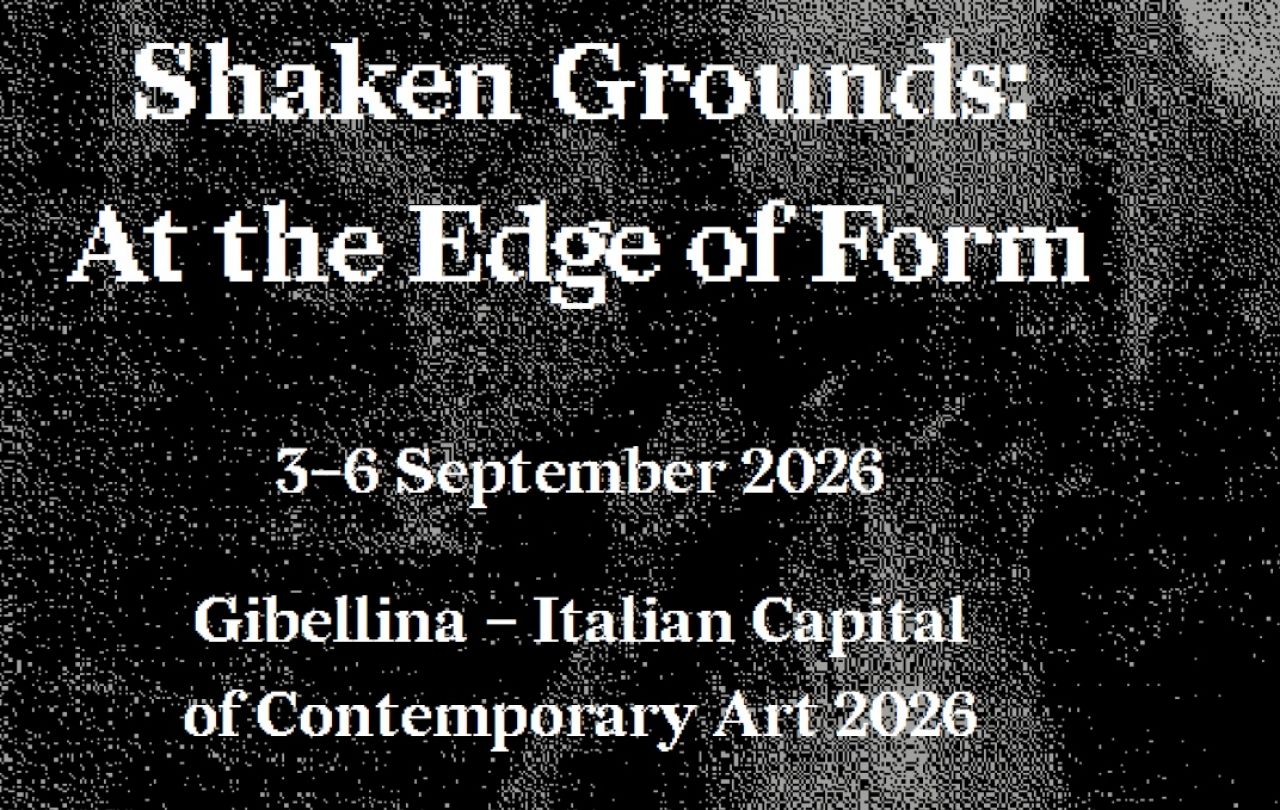
The collaboration with Gibellina – Italian Capital of Contemporary Art 2026 is part of the international co-creation project Creative Europe Shaken Grounds: Art as Seismography. The project brings together the Museum of Contemporary Art Zagreb (MSU), the University of Applied Arts Vienna, the Volcanic Attitude festival and the Iceland University of the Arts, together with partners from Austria and Italy.
Rather than following a conventional conference format, the programme unfolds over four days through different forms of encounter – from cinematic experience and collective artistic practice to interdisciplinary dialogue and reflection through the moving image.
At its centre are questions that are not posed as problems to be solved, but as ways of approaching the relationships between body and landscape, memory and the unconscious, the restless processes of the Earth, and our capacity to respond to them.
THURSDAY, 3 SEPTEMBER
Auditorium del MAC – Museo d’Arte Contemporanea “Ludovico Corrao”
Viale Segesta, 91024 Gibellina (TP), Sicily
18:30 – Opening Film Screening
Shaken Grounds, Shifting Skies
The short film connects the unstable landscapes of the Phlegraean Fields, Mount Vesuvius and the island of Vulcano in Italy with the Pasterze Glacier in Austria, which is retreating. Landscape images intertwine with scenes from an artist’s studio, exploring how seismic shifts in the environment – today further intensified by climate change, groundwater extraction, mining and waste – are reflected in the body and psyche.
Welcome Addresses
Salvatore Sutera, Mayor of Gibellina
Andrea Cusumano, Artistic Director of the Gibellina – Italian Capital of Contemporary Art 2026 project
The screening will be followed by an informal conversation with the Shaken Grounds collective: Nikolaus Gansterer, Mariella Greil, Victor Jaschke, Peter Kozek, Werner Moebius and Lucie Strecker.
FRIDAY, 4 SEPTEMBER
Sistema delle Piazze,
91024 Gibellina (TP), Sicily
17:00 – Live Recording
What Holds Us Before We Are?
With the Shaken Grounds collective.
SATURDAY, 5 SEPTEMBER
DAY PROGRAMME
Auditorium del MAC – Museo d’Arte Contemporanea “Ludovico Corrao”
Viale Segesta, 91024 Gibellina (TP), Sicily
SYMPOSIUM
Shaken Grounds: At the Edge of Form
9:30 – Welcome Coffee
10:00 – Opening Remarks
Claudio Saponara, Project Officer, European Commission
10:15 – Where Is the Edge of Form?
Lucie Strecker, Artist and researcher, University of Applied Arts Vienna
The lecture Where is the Edge of Form? develops the seismic metaphor through the artistic research of the Shaken Grounds project. Moving between geological, somatic, political, historical and aesthetic fields, it explores what becomes visible when these fields are brought into relation while their differences and gaps remain active. Drawing, movement, reconstruction, film and collective practice can create unexpected relationships and questions, challenging established forms of knowledge at their edges. Following seismicity towards the boundary between geological processes and human action, the lecture asks what we base our understanding on when familiar distinctions become unstable, and how artistic practice can redirect attention towards the possibility of living on shaken ground.
10:40 – Questions on Questions
Olga Bach, Writer, Palermo
Questions on Questions is a performative lecture that explores seismic uncertainty through the linguistic form of the question. Starting from ten questions from the Shaken Grounds project as a kind of score, the lecture explores what a question itself does and produces. Questions appear between moving images like intertitles in a silent film, yet instead of stabilising the image, they displace it. Like a crack, questions interrupt the flow of language and divide it into a before and an after. They open a space of uncertainty, suspend what preceded them, and at the same time anticipate what might follow – an answer, a reaction, or perhaps nothing. In Gibellina, a city whose history was divided by the 1968 earthquake into a before and an after, this reading asks whether language itself can also be shaken and displaced.
11:00 – Between Fear and Hope: From Seismic Vulnerability to Awareness and Response
Alessandro Amato, Geophysicist and seismologist, INGV, Rome
Since ancient times, people have sought ways of coping with earthquakes – attempting to explain their origins, predict them, and find ways of protecting themselves from their consequences. Theories about earthquakes have included natural phenomena, mythological figures and religious beliefs, in a continuous attempt to respond to the uncertainty inherent in seismic events. These attempts have also produced numerous artistic forms that transformed geological hazards into enduring visual symbols, embedding knowledge of the environment, collective memory and cultural identity. The lecture traces this history through examples of earthquakes documented by artists and poets and reflects on how art can complement science by increasing knowledge and awareness of risk – which is also the first step towards reducing it.
11:20 – Is the Heart of the Earth a Fiery Dog? Seismographies of the Incomprehensible
Nikolaus Gansterer, Artist and researcher, University of Applied Arts Vienna
What does it mean to stand on the ground on which we live without knowing what lies hidden beneath it? This lecture-performance, accompanied by film material, moves through research materials, sequences of images, associative visual representations and drawings, unfolding through a rhythm of slowing down and gradual opening. At its centre is the practice of attentive observation: sensing even the smallest vibrations and resonances like a seismograph, without defining them conclusively – recording them without fixing them. Between atmosphere, geosphere and egosphere, a field of active forces and resonances emerges, at whose edges what escapes final comprehension becomes visible: the transient, the perceptible and the incomprehensible.
11:40 – Isola Ferdinandea: An Ontopoetics of Emergence and Disappearance
Lorenzo Marsili, Philosopher and Director, Berggruen Institute Europe
In June 1831, a new island emerged from the sea between Sicily and Pantelleria. Within a few months, Britain, France and the Bourbons had placed their flags on it and given it the names Graham, Julia and Ferdinandea. By December, the island had disappeared beneath the sea, while the question of its sovereignty remained unresolved. Since then, it has been shelled, mapped and marked again with flags. Ferdinandea becomes a symbol of ontopoiesis – the continuous creation of reality without a predetermined essence or transcendent foundation. The island is not an object waiting to be given the “right” name, but something that comes into being through what it does: breaking through the Earth’s crust, displacing water and unsettling empires – and only for as long as it exists. Its competing names reveal the act of naming: it is not a discovery of Being, but a fragile creation of a shared world. Like the restless planet that today constrains us and changes our perspective, the island is not an inert stage, but an active participant in the story of life. Meaning emerges – and can disappear.
12:00 – Embodied Resonances Among Seismic Wave Ecologies: What Knowledges Emerge Between Tremor and Trauma?
Mariella Greil, Artist and researcher, University of Applied Arts Vienna
This contribution explores the entanglement of tremor, trauma and war-induced seismicity, asking what forms of knowledge emerge when these phenomena are understood simultaneously as geological, bodily, political and ecological processes. Moving between the registers of Earth and body, it considers how explosions, bombardments and other forms of militarised violence produce seismic resonances that extend beyond measurable waves and become traces, sensations, memories and enduring states of anticipation. In dialogue with Gibellina’s seismic history, trauma is approached here as a form of embodied resonance, while seismicity becomes a carrier of situated memory. What forms of knowledge become possible when tremor is listened to simultaneously as a geophysical signal and a traumatic record?
12:20 – Light Reading. A Playful Intervention on the Freedom of “Irresponsible” Eyes
Victor Jaschke, Independent filmmaker
Mariella Greil, Artist and researcher, University of Applied Arts Vienna
From the darkness, shadowy eyes observe the very act of looking – the moment in which, from our own darkness, we isolate what has truly been imprinted within us: two tiny images of light on the retina, which we then expand into an imagined space. The one who looks and their dark observer, through an exchange of roles and the relinquishing of the returned gaze, give one another the freedom and power of “irresponsible” eyes – to see the unseen and hear the inaudible, to feel, think and love more freely, and to be shaken without firm ground beneath us.
12:40 – Lunch Break
13:40 – Unstable Grounds: When the Ground Is Not Neutral
Artistic Practices from Croatia in the Context of the Shaken Grounds Project
Vesna Meštrić, Art historian, curator and Director of the Museum of Contemporary Art Zagreb
What happens when we can no longer understand the ground as neutral, but rather as a surface on which change is inscribed and becomes visible? Art does not only register moments of rupture, but also the tensions that precede them, gradual shifts that may go unnoticed, and the traces that remain. This raises questions about what produces instability, how it enters space and the body, and whose experience becomes visible. Drawing on the MSU collection, the presentation brings together works by Mangelos, Edita Schubert, Dalibor Martinis, Mirjana Vodopija, Toni Meštrović, Tin Dožić and Sara Salamon. Their works move between landscapes marked by war, imperceptible vibrations, shifts in perception and geological changes shaped by human activity, opening a perspective on the ground as a space marked by environmental, technological and political pressures.
14:00 – Volcanic Attitude “Vibrant Elements”: A Nomadic Festival Activating Enduring Transformations
Conversation and video screening
Helga Franza, Susanna Ravelli, Giulia Restifo, Curatorial team of the Volcanic Attitude festival
What happens when artists, scientists and researchers from different disciplines come together to exchange ideas on top of a volcano or while travelling through geological formations that reveal ancient times and forces? How does our perception of nature and geological time change our relationship to art and research? The conversation will explore the development of the experimental festival launched in 2021, which unfolds along routes connecting Naples, Stromboli and Vulcano. The festival brings together artists, scientists, philosophers, anthropologists and researchers from different fields in places where nature itself becomes an active participant, opening up space for new rules and new visions. Projects and research from different editions of the festival will be presented.
14:30 – Final Discussion
Moderated by Vesna Meštrić
SATURDAY, 5 SEPTEMBER
EVENING PROGRAMME
Chiesa Madre
Viale Vitaliano Brancati, 91024 Gibellina (TP), Sicily
Lecture-Performances and Collective Improvisation
19:00 – Aperitivo
19:15 – What Takes Root on Shaken Ground?
Shaken Grounds collective
A fifteen-minute collective somatic practice based on Joseph Beuys’s suggestion that “earthquakes in palaces are still going on” and Irene Dowd’s Taking Root to Fly, with anatomical attention directed towards the spine as a structure that simultaneously provides support, mobility and orientation.
19:30 – Vertical Horizon
Anna Líndal, Artist and researcher, Iceland University of the Arts
Bjarki Bragason, Artist and Dean, Iceland University of the Arts
Vertical Horizon is a new collaborative work by artists Anna Líndal and Bjarki Bragason. For more than twenty years, their practices have been connected by an interest in the elements that shape environments and the ways in which change unfolds, is perceived and becomes inscribed in places and objects. The six-minute video consists of three components. At its centre is the perspective of a person rising from a depth of 120 metres, from the magma chamber of Þríhnúkagígur, a volcanic cave in a mountain near Reykjavík. The slowed-down image passes through layers of lava visible in the narrow opening of the magma chamber, while on either side a kind of measurement takes place: a measuring tape more than 100 metres long is extended and retracted. Líndal and Bragason explore the ways in which human activity is connected to the Earth and its systems, which operate on timescales entirely different from those of human experience and intentions.
The Earth does what it wants.
The screening will be followed by a conversation with the artists.
20:00 – Can Thought Tremble?
Jam session inspired by Édouard Glissant
An open collective improvisation inspired by Édouard Glissant’s concept of “trembling thought”. In an open experimental environment, text, performance, live editing and sound design, costume and scenographic elements, and objects enter into a free interplay. The jam session offers an immediate insight into the project’s working methods and explores the concept of “trembling thought” through artistic practice. Here, seismography is understood not only as a scientific method, but also as an artistic practice of listening, recording and connecting. The encounter is open to the public: visitors can discover the artistic research, ask questions, join the improvisation or take part in the conversation.
SUNDAY, 6 SEPTEMBER
Auditorium del MAC – Museo d’Arte Contemporanea “Ludovico Corrao”
Viale Segesta, 91024 Gibellina (TP), Sicily
21:00 – Film Evening
How Does Imagination Affect the Earth’s Crust, and How Does the Earth’s Crust in Turn Affect Imagination?
A selection of films and moving-image works exploring seismic landscapes, environmental transformations, deep time, artistic witnessing, and changing relationships between the human and the more-than-human world. The programme is curated and moderated by Peter Kozek.
BIOGRAPHIES
Alessandro Amato is a geologist and holds a PhD in geophysics. He is currently a research scientist at the National Institute of Geophysics and Volcanology (INGV) in Italy. He has studied numerous earthquakes in Italy and throughout the Mediterranean region and has coordinated national and international projects in seismic and tsunami research and risk assessment. He served as Director of the National Earthquake Centre (2001–2007; 2012–2013) and Head of the Italian Tsunami Warning Centre (2017–2025). He was also a member of the Major Risks Commission in the seismic and tsunami section. Since February 2024, he has served as Chair of the UNESCO-IOC Intergovernmental Coordination Group for the Tsunami Warning and Mitigation System in the North-Eastern Atlantic, the Mediterranean and Connected Seas (NEAMTWS). He is active in science communication and is the author of scientific books, including two co-authored volumes on science and law. In 2026, he received the Enrico Fermi Prize of the Italian Physical Society.
Olga Bach was born in Berlin in 1990. She studied philosophy and German studies at Freie Universität Berlin and Istanbul University, and subsequently studied law at Humboldt University of Berlin. While still a student, she began writing plays that were performed at leading theatres in the German-speaking world, often directed by Ersan Mondtag. Her play Die Vernichtung was nominated for the Mülheim Drama Prize and invited to the Berlin Theatertreffen in 2017. That same year, Theater Heute named her Emerging Playwright of the Year. In 2023, she published her debut novel Kinder der Stadt with Kiepenheuer & Witsch. Since 2026, she has been Head of Theatre Programming at Teatro Garibaldi in Palermo.
Bjarki Bragason studied at the Iceland University of the Arts, Universität der Künste Berlin and CalArts in Los Angeles. He is Associate Professor and Dean of the Fine Arts Department at the Iceland University of the Arts and has taught internationally since 2014. His current research focuses on a long-term project that considers his grandparents’ garden as a site of transformation and places it in relation to landscapes shaped by geological events and climate change.
Helga Franza is a multidisciplinary artist and curator whose work explores connections between different perceptions of planetary time and space. She works across sculpture, drawing, painting, collective and curatorial practices, creating contexts for encounters between art, science and research. She is co-founder of Cose Cosmiche and the Volcanic Attitude festival, a nomadic festival connecting artists and experts with volcanic territories and the primary forces of nature. She also founded Fondazione Arthur Cravan, which supports artistic ideas and projects considered “unrealizable”.
www.helgafranza.org
Instagram: @fondazionearthurcravan
Nikolaus Gansterer is an artist and researcher whose practice encompasses drawing, performance, installation, board compositions and cartography. His work explores relationships between micro- and macro-systems, atmospheres and geological locations, with a particular interest in diagrammatic and embodied forms of recording. He is a member of the Angewandte Performance Laboratory at the University of Applied Arts Vienna, where he exhibits and teaches internationally.
Mariella Greil works in the field of contemporary performance, particularly its connections with choreography and ethics. She develops a politicised and ethical-aesthetic practice and explores how artistic strategies can contribute to developing future scenarios of living in response to global challenges. She is a senior artist at the Angewandte Performance Laboratory and performs and teaches internationally.
Victor Jaschke is a filmmaker and artist working across Europe and Indonesia. He studied at the Vienna Film Academy and collaborates with artists and interdisciplinary groups on projects in performance art and artistic research, as well as on sociological and anthropological film projects in Indonesia. His films and collaborative works have been presented internationally, including in Vienna, Rome, Venice, Berlin, Naples, Jakarta, Bandung, Bishkek and Yogyakarta.
In his artistic practice, Peter Kozek explores local conditions and landscapes, their past, present and future, as well as their economic and social dimensions. Through art and performance, regions become spaces of transmission between myths, realities, and fictional and constructed worlds. His work has been presented internationally, including at mumok in Vienna, Power Station of Art in Shanghai, steirischer herbst and Nationaltheater Mannheim. He is a senior artist at the Angewandte Performance Laboratory at the University of Applied Arts Vienna, where he teaches performance and space, and also teaches at the Department of Art and Science.
www.peterkozek.com
kozek-hoerlonski.com
Anna Líndal is a visual artist based in Reykjavík whose research practice explores intersections between science, nature and social structures. Drawing on experiences in nature and expeditions with scientists, she explores how measurement, scale and temporality shape our understanding of the world, particularly at sites where human and geological timescales meet. From 2026 to 2027, she is a research professor within the new research cluster Studies on Earth.
Lorenzo Marsili is an activist and philosopher and Director of Berggruen Institute Europe. He is the founder of several social enterprises, including the transnational NGO European Alternatives and the cultural institution Fondazione Studio Rizoma.
His research and public work focus on imagining and developing futures beyond the nation-state. He is the author of Citizens of Nowhere (2018), Planetary Politics (2020) and Concrete Universality: Philosophy for an Age of Fragmentation (2026).
Vesna Meštrić is an art historian, curator and museum professional and Director of the Museum of Contemporary Art Zagreb, a position she has held since 2024. She has worked at MSU since 2005, and her professional work is closely connected with museum collections and archives. Her interests focus on contemporary art, post-war avant-garde and neo-avant-garde practices, and time-based media. She was the curator of the exhibition Vjenceslav Richter: Rebel with a Vision, for which she received the Croatian Association of Art Historians’ annual award for Best Exhibition in 2017. She participates in international conferences, research projects and professional programmes dedicated to contemporary art, museum practice and collection research.In 2017, with the support of the Andrew W. Mellon Foundation, she participated in MoMA’s inaugural workshop dedicated to the care of time-based artworks in museum collections.
Werner Moebius works at the intersection of visual art and music, within the expanded field of sound art and aesthetic practice. His work explores the plasticity of sound through acoustic, intermedial and performative contexts, connecting new music, electroacoustic improvisation, conceptual art and artistic research. He is a recipient of the City of Vienna Award, the Sussmann Foundation Award, and BMUKK grants for artistic residencies in Chicago and Mexico.
Susanna Ravelli is an independent researcher, curator and project manager working between Cremona and Milan. Her work focuses on contemporary art and culture, artistic research, territorial development and socially engaged projects. She is co-founder of the Volcanic Attitude festival, coordinates Hydroradio and runs the nomadic residency programme Grand Tour en Italie. In Cremona, she runs the contemporary art space It’s Hard Noise, dedicated to socially and politically engaged practices.
itard.it
www.volcanicattitude.org
Giulia Restifo is a cultural professional working across contemporary art, urban dynamics and cultural wellbeing. She is the founder and director of the platform That’s Contemporary, which maps Milan’s contemporary art scene and promotes transdisciplinary projects with social impact. She is President of the Casa degli Artisti Consortium, Artistic Director of the La Materia delle Isole project in the Aeolian Islands, and co-organiser of the Volcanic Attitude festival.
Lucie Strecker is an artist and researcher whose installations and performances involve non-human entities and experimental systems. She uses micro-performativity to question human scales of perception, highlighting biological and technological micro-agencies in relation to art and history. Her work has been presented in international exhibitions, performance contexts and artistic research programmes. She is a member of the Angewandte Performance Laboratory and teaches performance practices at the University of Applied Arts Vienna. She is co-editor of the publications On Micro-performativity (2020) and Life Is Other (De Gruyter, 2025).
SHAKEN GROUNDS
The project is supported and co-funded by the European Union, the Austrian Science Fund (FWF), the Austrian Cultural Forum Rome, the Austrian Federal Ministry of Housing, Arts, Culture, Media and Sport, and the City of Gibellina.
Funded by the European Union. Views and opinions expressed are however those of the author(s) only and do not necessarily reflect those of the European Union or the European Education and Culture Executive Agency (EACEA). Neither the European Union nor EACEA can be held responsible for them.