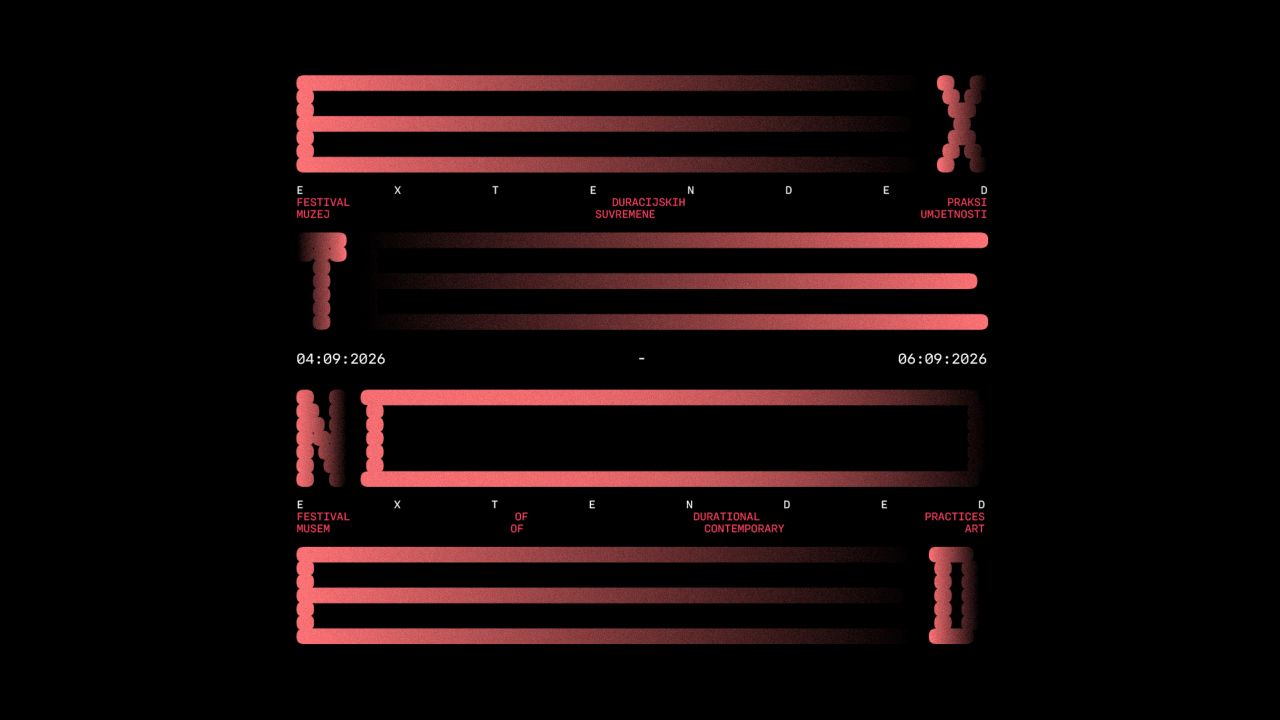
The art organization Istovremeno/Samtempe, in collaboration with the Museum of Contemporary Art, presents the first Extended festival, which opens up space for durational performances realized across different media – from contemporary dance, performance, and media art, to sound art, theatre, and various hybrid formats. The title implies extended duration, a departure from established modes of watching, creating, and performing.
Contemporary society functions through a rapid exchange of information that we process only partially. The accelerated pace of life has brought on hyperexposure to stimuli that have multiplied over the past two decades, while, consequently, the capacity to sustain focus and attention on a given content has drastically diminished. Social networks, marketing and media posts prey on our attention, turning us into reactive and passive consumers of content that changes at great speed, resulting in a kind of overload and a shift in cognitive capacities. Overstimulation is an elemental problem of contemporary Western, capitalist society. In order to create conditions for stepping away from such conditions of living and working, we are opening up space for a different consideration of time, attention, viewing, and performing. It is a space of experimentation in which we question how long we can endure together, how much information we need and how much is enough to remain in contact with the artwork, the performance, or ourselves. For artists, it is an invitation to reconsider their own practice differently, to question various directions of expansion – of aesthetics, ethics, media, and identity.
SCHEDULE
FRIDAY, 9/4/2026
10 am– noon Opening with discursive framework, Gorgona
Dr. Renata Geld, Andrea Milat, and festival participants and organizers (Monika Błaszczak, Tomislav Čuveljak, Tin Dožić, Martin Hargreaves, Željka Klemenčić, Kajsa Wadhia, Moa Franzén, Tove Salmgren, Marina Petković Liker, Ana Škegro, Tena Bošnjaković, Josipa Bubaš)
Noon – 1 pm festival gathering to chat over drinks
1 pm – 7 pm Monika Błaszczak: Soliloquy 09.04.2026, MSU installation
7 pm – 10 pm Tin Dožić: Straight Line, Gorgona
all day Tomislav Čuveljak: Moving, video installation, MSU installation, 2nd floor
all day Željka Klemenčić: Perpetual Stew, MSU plateau
SATURDAY, 9/5/2026
11 am – 5 pm Martin Hargreaves: Perhaps I Have No Time I Have No Time Perhaps, Gorgona
4 pm – 7 pm Tender Motor: tender motor, Školica
7 pm – 11 pm Marina Petković Liker: Let me hear you, Gorgona
all day Tomislav Čuveljak: Moving, video installation, MSU installation, 2nd floor
all day Željka Klemenčić: Perpetual Stew, MSU plateau
SUNDAY, 9/6/2026
10 am – 8 pm Tena Bošnjaković: Tena & Tena, MSU lobby
1 pm – 3 pm Josipa Bubaš: Extended Body Language, workshop, Školica
3.15 pm – 5 pm Josipa Bubaš: Extended Body Language, performance, MSU plateau and lobby
THE WORKS AND PERFORMER:S
DISCURSIVE PROGRAM
Introducing the theme, artists, and program.
Renata Geld is a tenured professor at the Department of English at the Faculty of Humanities and Social Sciences, University of Zagreb, founder and director of the Center for Cognitive Science, and head of the first program in applied cognitive science in Croatia and the region. She was educated in Zagreb, the United Kingdom, and the United States, earned her PhD in cognitive linguistics at the University of Zagreb, and conducted part of her doctoral research at the Universidad Nacional Autónoma de México in Mexico City. Her research interests center on cognitive linguistics, linguistic and multimodal meaning-making, 4E cognition, and human–machine interaction, as well as the application of cognitive science to learning and teaching. She is the author of numerous books and scholarly papers, and has given invited lectures and plenary talks at universities and conferences around the world, including in the United States, China, and the Middle East, among others. She has received the University Award for Advancing International Cooperation and the Annual Science Award of the Faculty of Humanities and Social Sciences, University of Zagreb.
Andrea Milat has an MA in linguistics and Indology, and is working on a doctoral thesis in cognitive neurolinguistics focusing on the relationship between language, thought, and experience – to be finished someday, or perhaps in retirement. She is a journalist and researcher writing on science, society, language, and culture. In her pieces for Novosti magazine, she has occasionally written on meditation, mindfulness, and various interpretations of awakening experiences. She encountered the philosophical and religious traditions from which some of these concepts originate during her studies in Indology. She is interested in how language, attention, the body, and prior knowledge take part in the creation and interpretation of meaning.
PERFORMANCES
Monika Błaszczak, Soliloquy 04.09.2026
Soliloquy is a movement practice and choreographic project studying the ghosts carried by the body. It functions both as a practice taught in workshops and classes and as a series of performances. Each performance is different but rooted in the practice, carrying its date in the title and responding to a specific place and the presences embodied within it. For the Museum of Contemporary Art in Zagreb, a new iteration unfolds as a durational performance. The dancer makes movement gifts addressed to those present and to figures that have shaped her, including the ghost villages in the Carpathian Mountains, distant ancestors, and the surrounding environment. Visitors can enter and leave at any point during the performance.
Monika Błaszczak - Polish-Łemko dancer and choreographer based in Berlin. Her work has been presented internationally at venues including Tate Modern, Victoria and Albert Museum, Barbican Centre, South London Gallery, The Place, Laban Theatre, Polish Dance Theatre, and Volksbühne – Grüner Salon. In 2025 she founded Monika’s Dance World, a Berlin-based dance company working internationally. She is also the creator of Soliloquy – Hauntological Somatics, a movement practice and choreographic research that treats the body as a site of memory and a portal to change. She graduated from NYU Tisch School of the Arts and Trinity Laban Conservatoire of Music and Dance in London, both on full scholarships. She is also a professional ballerina. She has received awards including the Young Poland Scholarship and the Trinity Laban Innovation Award. Her passion for the transformative power of dance grows every day. https://monikablaszczak.com/
Tin Dožić, Straight Line
Straight Line is an extended electronic music performance in drone form. Drawing on the tradition of long-form musical works by artists such as Theatre of Eternal Music, Eliane Radigue, and others, Straight Line will be shaped by a monotonous, meditative sound. For the performance, the artist uses analog electronic instruments – analog sound synthesizers, a DIY modular sound synthesizer, and various homemade devices. The overall sound of the performance is established from the very first second and flows on indefinitely.
Tin Dožić (b.1989, Rijeka) is a contemporary younger generation artist whose practice frequently starts from the medium of sound. He completed his studies in psychology at the Faculty of Croatian Studies, University of Zagreb (2016), and in new media at the Academy of Fine Arts in Zagreb (2016), and works in field recording, radio, experimental music, and multimedia installation. His practice has recently shifted from primarily sound-based works toward multimedia, with a focus on the investigation of media itself.
Tomislav Čuveljak, Moving
Moving is an ambient video installation consisting of four video works mounted on partition walls, with a fourth work projected onto the floor, and an accompanying audio composition consisting of Earth sounds. The video works shown are meditative in character and were created through the collaboration of Josipa Bubaš and Tomislav Čuveljak on the productions Ponovno uranjanje, Vrt te Prostori, prostranstva; together they form a distinct visual whole unified by the theme of movement.
Tomislav Čuveljak (b. 1964) is a photographer and cinematographer from Zagreb. His photographs have been published in various media, notably in Nacional magazine. He worked at Croatian Radiotelevision (HRT) as a sound engineer and as a war cameraman. He is the author of several music videos (for artists such as Legen, Dunja Knebl, Only Bass'n'Drum) and numerous book covers for renowned publishing houses, primarily Profil (for example the covers of works by Ivan Supek, Tena Štivičić, Josip Manolić, Rade Šerbedžija, etc.). He has exhibited both in solo shows and in group exhibitions, including Kazalište i oko njega – digitalno i analogno, Događanja Gallery, Zagreb and Tvrđa, Osijek, 2003, Božja mašina – izvana (T. Gotovac), Mimara Museum, 2011, Dani sjećanja na Vladu Gotovca, Cultural and Information Center (KIC), 2013, Jedan grada, dva fotografa (with Damir Kalogjera), Cultural and Information Center (KIC), 2015. He took the photographs of Tomislav Gotovac's work Foxy Mister, held in the permanent collection of the Museum of Contemporary Art. Together with Josipa Bubaš he has realized several performative-visual works, for which he authored the video. He is a graduate of the Academy of Dramatic Art, Department of Cinematography.
Željka Klemenčić, Perpetual Stew
Perpetual Stew is conceived as a two-day, all-day continuous cooking of various simple foods in one large pot. Over the course of the day, the artist empties the pot – serving guests soup and stew – and continually adds new ingredients, so the contents keep changing while remaining in the same pot. The artist is interested in the form of the perpetual stew from several viewpoints: as a simultaneous act of resistance to fast food (a symbol of consumer society) and to slow food (a symbol of elitist consumption); as a living image of the endless, invisible, and socially unrecognized labor of women within families; and as an intimate act of sharing food with strangers, in which the food from the pot serves as social glue and offers an opportunity for a cultural melting pot.
Željka Klemenčić is a journalist and writer with many years of editorial experience at leading Croatian media outlets. Over the past fifteen or so years she has specialized in gastronomy as an important facet of cultural identity. She was the founder and editor-in-chief of Croatia's leading gastro-magazine Dobra hrana, a part of the Jutarnji List Sunday edition (2010–2012). She subsequently went independent and launched her own independent, multimedia gastro-magazine at www.mrvica.hr. Mrvica is a multimedia platform promoting natural production, championing the best local products and producers, educating consumers, and advancing ideas of sustainable development in domestic tourism and gastronomy. Željka is the editor, publisher, and author of the contemporary Croatian cookbook Mrvica svaki dan (2014). She served as a juror on the TV show 3-2-1 kuhaj! (3-2-1 Cook!) for nine seasons. Since 2019 she has been running workshops and consultations on healthy nutrition for children and adults. In late 2019 she published a cookbook for mothers of young children titled Sretno dijete koje jede sve (A Happy Child Who Eats Everything).
Martin Hargreaves, Perhaps I Have No Time I Have No Time Perhaps
Borrowing from Jacques Derrida’s insistence on the parasitism of performativity, and working with Mladen Stilinović’s promising threats of language, this lecture inquires about the event of performance and the temporality of speech acts. It will address expected delays, unfulfilled promises, unsatisfied seduction, failed seriousness and unmet demands.
Martin Hargreaves is a dramaturg, writer, and performer and his research practices range between boredom and hysteria. His primary interests are in the recent history of contemporary dance, queer performance arts, and camp misunderstandings. In 2003 he was awarded a PhD for his thesis entitled Performativity, Spectrality, Hysteria and from 2003 to 2013 he was the Editor of Dance Theatre Journal. From 2005 to 2015 Martin was Programme Leader of the MA programme The Body in Performance at Trinity Laban. He has worked recently with Pablo Bronstein, Boris Charmatz, Joan Jonas, marikiscrycrycry, Nicola Conibere and Yvonne Rainer. He is on the Artistic Research Advisory Committee for the Stockholm University of the Arts and is a trustee of the Dance Art Foundation. He also collaborates with the H2Dance collective as an advisor for the festival programme of Fest en Fest.
Tender Motor, tender motor
The performances of Tender Motor take the form of choreovocality as point of departure, where the voice works as the primal choreographic and performative material. Tender motor uses the voice both as a tool and a place to explore gender and the human in order to find gaps and cracks in our politicised, socialised and ideologised bodies and voices. Through radical trust in the process, in one another, and in the collective, and the affective, mutating force that defines the body, the performance practice weaves inward and outward, continuously being carried by expansive, soft, pulsating, rhythmic, desiring, joyous, vibrating, and listening forms and sounds.
Tender Motor is a non-disciplinary performance trio with backgrounds in visual arts, poetry, choreography, dance and art curation. The group consists of Kajsa Wadhia, Moa Franzén, and Tove Salmgren, a collaboration that has been exploring performance art and choreography since 2018 at the intersection of sound, breath, and movement. The group composes, improvises, and creates live works, curated events, and publications based on a radically process-oriented method that integrates all aspects of their lives into their shared artistic practice. Since January 2025, the group has been running the two-year research project Sonorous Dances and Reverberant Matters, supported by the Stockholm University of the Arts’ artistic research program.
Marina Petković Liker / ČETVERORUKA, Let me hear you
Lonely, lost, trying to find a safe place, a better job, better living conditions – the strangers who surround us, many of whom people fear, who cannot count on our kindness, communication, or open hearts, trying to keep to themselves, not draw attention, not to bother anyone, are still living or surviving – in relationships they don't understand, in relationships we don't understand, without language, without speech, without touch, without contact. Who are we, while we ask ourselves (or don't ask) who they are? What story do they tell?
The project Let Me Hear You is Četveroruka's attempt to use the medium of performance to open up a space for dialogue with and about migrants and foreign workers who are part of our local community. Motivated by the question of communication as a painful point that prevents encounter with those who speak other languages, who come from other worlds – who are present, but not seen – this project is an attempt to open up the question: how do we understand one another when we speak different languages? And can we even hear one another if we don't dare look at each other? What happens when we find ourselves in a space where words aren't enough – or aren't available at all?
This open showing of a work in progress is a step in an artistic research process that is only just moving toward the development of a final performance. It is a space for entering into dialogue between the creative team, the performers, and the audience. The language we will use is the language of theatre: it rests not on speech, but on presence, sensuality, and relation. It consists of looks, sounds, images, smells and tastes, the giving of attention, words spoken with care, a focus turned both outward and inward.
We invite you to share time and attention together, to explore communication beyond language, while still remaining within the space of listening and looking – where we would otherwise stay silent and look away.
Creative team:
Author and director: Marina Petković Liker
Dramaturg: Maja Sviben
Performers: Silvia Marchig and Danijel Ljuboja, in collaboration with Prisca Dhombo and Deepika Deep
Set and costume designers: Ana Paulić and Ivana Radić
Project development collaborator: Vida Zelić
Lighting design: Saša Fistrić
Marina Petković Liker is an author and director interested in the cracks within language, memory, and performance. She works at the intersection of theatre, the verbal and nonverbal in physical performance, and film and documentary, often starting from real experiences and personal histories. Her work explores what is difficult to say, yet can still be heard, seen, and performed. She is the founder of Četveroruka.
ČETVERORUKA is an art organization dedicated to opening new fields within theatrical art. Founded in 2013, it operated in the field of music-theatre, theatre, dance, and audiovisual artistic creation. Through its diverse artistic work, it is dedicated to developing innovative artistic practices and promoting social sensitivity. The main focus of its activity and programme is artistic research aimed at questioning and reaffirming existing artistic forms and their communication with audiences. It advocates for an engaged and empathetic approach to intimate and collective themes, and for the continual questioning of performative forms and their relationship to contemporary social currents and ongoing changes.
Josipa Bubaš, Extended Body Language
Extended Body Language is a multi-year research project by artist, performer, and educator Josipa Bubaš. Through the project presentation, interested participants will have the opportunity to gain insight into the work methodology as well as the process and experiences generated during the research itself. The presentation is conceived in two parts:
1 / a two-hour workshop in which participants gain insight into the working methodology,
2 / a presentation of the research, in which we immerse ourselves in the processes of performers Ivana Ognjanovac, Ivana Pedljo, Mia Štark, and Sindri Uču.
The project "Extended Language of the Body" deals with extended cognition, the interplay of sensation, movement, association, imagination, thought, and language. It delves into the connections and fissures between thought and sensation, body and environment. The practice involves observing, uncovering, and playing with unusual possibilities of perception through specific work with attention and language.
Josipa Bubaš is a performing artist working in the genre of performance art, an art historian, and an educator. She is a member of AICA, ULUPUH, and UPUH. She graduated in Art History and English Language and Literature from the Faculty of Humanities and Social Sciences in Zagreb. She earned her PhD from the Department of Interdisciplinary Humanities at the University of Zadar in 2020. As a performer and co-author she has taken part in various performance projects. Since 2012 she has been engaged in authorial work, creating performative forms that draw on the vocabulary of physical theatre and contemporary dance. She has performed numerous works at festivals and in gallery, museum, and public spaces. She is the author of numerous professional texts as well as interviews with contemporary visual and dance artists. She works at the Centre for Visual Arts Education of the City of Zagreb as a senior program associate, and as a Senior Assistant at the Academy of Fine Arts as an external associate. Since 2025 she has been enrolled in the New Performative Practices program at Stockholm University of Arts (Stockholms konstnärliga högskola). www.josipabubas.com
Tena Bošnjaković, Tena & Tena
Tena & Tena is a multi-year multimedia art project exploring identity through play with the name Tena, examining the relationship between a person, a product, and a place that share the same name. At the center of the project is dramaturg Tena Bošnjaković, surrounded by objects, texts, brands, and locations that share her name: oil, flour, semolina, wafers, sanitary pads, champagne, literary characters, and various geographic places. This durational performance is part of a multi-year research process through which the artist opens up a space for conversation about Tena. The name as a personal marker, a market label, a social sign, and performance. Material. The project starts from the question of what happens when a personal name becomes a product name, and how an endless series of objects bearing the same name affects one's own sense of identity.
Tena Bošnjaković graduated in dramaturgy from the Academy of Dramatic Art in Zagreb. She is the author of three short documentary films: Kampanja (The Campaign), Ona koja se kupala na Bačvicama (She Who Bathed at Bačvice), and Jules. As a dramaturg she has collaborated on numerous dance and performance projects, and her recent authorial work has developed through multimedia authorial projects. Among her recent works is Tijelo traume (The Body of Trauma), which premiered in 2025 at Pogon. The same year saw the creation of Sve što nisam znala reći (Everything I Didn't Know How to Say), developed through the residency program of the Zagreb Dance Centre. In 2026, through a ZPC residency, she is developing the multimedia project JOUSKA. That same year she began the multi-year authorial research project Tena & Tena, focused on the long-term exploration of identity, physicality, autobiographical material, and performative duration. Alongside her authorial and dramaturgical work, she has many years of experience in producing performance and interdisciplinary projects, festivals, and programs, as well as working on international and European projects. Her production experience includes project development and coordination, collaboration with artists and partner organizations, program implementation, and the organization of performance events. She also leads screenwriting workshops, connecting her dramaturgical and film experience with educational work.
Program organization: UO Istovremeno (Josipa Bubaš), MSU Zagreb (Ana Škegro)
Production: Tena Bošnjaković
Thanks to: Radiona, Fronesis
This program was realized with the support of the City of Zagreb, the Ministry of Culture and Media of the Republic of Croatia, the Kultura Nova Foundation, and the Zagreb Tourist Bo